EN
EN

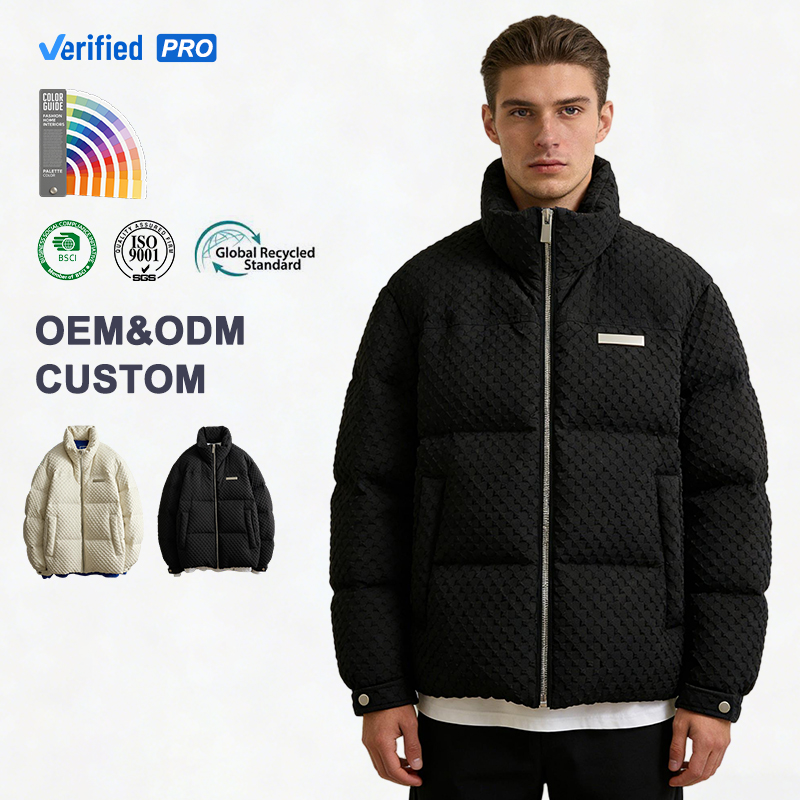
The Science Behind Down’s Exceptional Warmth-to-Weight Ratio
A down jacket owes its legendary warmth-to-weight ratio to the unique structure of down clusters—soft, three-dimensional plumules that trap millions of tiny air pockets. These pockets dramatically slow conductive and convective heat loss. The key metric quantifying this efficiency is fill power: a lab measurement of how many cubic inches one ounce of down occupies when fully lofted under standardized conditions. Higher fill power means more air-trapping volume per gram—enabling exceptional thermal resistance without added weight. That’s why a high-fill down jacket can feel intensely warm yet weigh mere ounces, consistently outperforming synthetics in warmth-per-gram performance.
Loft and Fill Power: How Air Trapping Creates Efficient Insulation
Loft is the physical expression of down’s insulating ability—the degree to which clusters expand to create stable, insulating dead-air space. Fill power measures that capacity: 800-fill down occupies 800 in³ per ounce; 600-fill, just 600 in³. Greater loft means more warm air held close to the body. This makes high-fill down ideal for weight-sensitive applications—from alpine ascents to ultralight backpacking. For instance, an 800-fill jacket can match the warmth of a 600-fill model using 30% less down by leveraging superior loft efficiency. It also packs into a palm-sized stuff sack and rebounds rapidly to form a thick, responsive thermal barrier—critical for dynamic outdoor use.
Why Higher Fill Power Doesn’t Always Mean Better Warmth—Context Matters
Fill power alone doesn’t guarantee superior warmth. Real-world thermal performance hinges on total fill weight, baffle design, shell fabric breathability and wind resistance, and fit. A 900-fill jacket with only 80g of down may feel cooler than a 650-fill jacket with 150g in windy or highly active conditions—because air movement overwhelms loft-based insulation faster than bulkier down can compensate. Lower-fill down also tends to be more durable and compressions-resistant over time. As the Outdoor Industry Association notes, optimal fill power depends on use case: high-fill (800–900) excels in cold, dry, static environments where minimal weight and pack size are priorities; moderate-fill (600–750) offers better resilience in wetter, windier, or abrasion-prone settings where longevity and consistent loft under pressure matter most.
Fill Weight Optimization: Maximizing Thermal Performance Without Added Bulk
Nonlinear Warmth Gains: Why Doubling Fill Weight Rarely Doubles Warmth
Down generates warmth primarily through trapped air—not mass. When excess down is compressed into fixed baffle chambers, clusters lose loft, shrinking the insulating air layer. This leads to diminishing thermal returns: each additional gram contributes less clo (a standard unit of thermal insulation) than the one before it. For example, increasing fill weight from 80g to 160g in a mid-layer mountaineering shell typically raises clo value by only 30–40%, not 100%. Designers therefore optimize baffle height, chamber width, and stitch placement to preserve loft at target fill weights—ensuring every gram performs efficiently. This nonlinear relationship explains why top-tier down jackets achieve elite warmth-to-weight ratios not by over-filling, but by engineering precise, loft-preserving construction.
Real-World Comparison: 85g of 900-Fill vs. 140g of 650-Fill Down Jackets
An 85g 900-fill down jacket often delivers warmth comparable to a 140g 650-fill counterpart—despite weighing nearly 40% less. That’s because 900-fill down occupies roughly 38% more volume per gram than 650-fill, forming a thicker, more effective air barrier. In moderate conditions (0–10°C), the lighter jacket feels equally warm while offering superior packability and mobility—making it ideal for travelers, trail runners, and multi-sport athletes. However, in extreme cold (<–15°C) or high-wind exposure, the advantage narrows: thicker baffles and higher total fill weight become critical for sustained heat retention. Contextual performance—not just specs—determines real-world suitability.
Engineering for Lightweight Warmth: Baffles, Shells, and Construction
How Precision Baffle Design and High-Tenacity Nylon Preserve Loft and Minimize Cold Spots
How down is contained matters as much as how much is used. Stitch-through baffles—where outer and inner shells are sewn directly together—are lightweight but create cold spots at each stitch line, allowing heat to escape and down to shift. In contrast, box-wall baffles form true 3D chambers, letting down loft fully and evenly across the garment. This eliminates gaps, ensures uniform insulation, and prevents cold bridging. Paired with high-tenacity, ultralight nylon shells (e.g., 7D or 10D ripstop), these baffles resist tearing and abrasion without sacrificing breathability or weight. Emerging welded-baffle construction takes this further—using ultrasonic bonding instead of thread—to eliminate stitch holes entirely, reduce down migration, and improve weather resistance. Together, these innovations preserve loft, maximize thermal efficiency, and eliminate weak points in the insulation system.
Modern Down Jacket Trends: Ethical Sourcing, Packability, and Performance Balance
Today’s down jacket market reflects three converging imperatives: ethical sourcing, intelligent packability, and balanced performance. Consumers increasingly demand transparency—not just in fill power, but in animal welfare and environmental impact. Certifications like the Responsible Down Standard (RDS) and Global Traceable Down Standard (TDS) verify humane treatment and full supply-chain traceability, and leading brands now publish annual sourcing audits and adopt recycled nylon shells. Simultaneously, packability has evolved beyond compression ratios: modern high-loft down recovers >95% of original loft after extended storage, enabling reliable pocket-sized packing without performance compromise. Finally, performance balance means designing for how the jacket will be used—not just how warm it can get. Manufacturers now tailor fill weight, baffle layout, and shell fabric to specific activities (e.g., 100g fill for ski touring, 60g for urban layering), ensuring warmth, breathability, durability, and mobility coexist. This holistic approach delivers down jackets that are warm, portable, responsible—and engineered for real life.
FAQ Section
What is fill power in a down jacket?
Fill power refers to the measurement of how many cubic inches one ounce of down occupies when fully lofted. Higher fill power indicates better air-trapping efficiency per gram, resulting in superior insulation and warmth-to-weight performance.
Is a higher fill power always better for warmth?
Not necessarily. While higher fill power often provides better loft and insulation efficiency, total warmth depends on factors like fill weight, baffle design, shell fabric, and context of usage (e.g., windy or wet conditions).
What is the difference between box-wall and stitch-through baffles?
Box-wall baffles create 3D chambers for uniform down distribution and superior insulation, eliminating cold spots. Stitch-through baffles are lightweight but prone to cold bridging due to heat escaping at stitch lines.
How does ethical sourcing impact down jackets?
Ethical sourcing ensures humane treatment of animals and environmental sustainability. Certifications like RDS and TDS verify ethical supply chains, supporting customers' demand for transparency and responsibility.
Are high-fill down jackets suitable for extreme cold?
High-fill jackets excel in moderate conditions with weight sensitivity. In extreme cold or high winds, emphasis shifts to total fill weight and baffle design for sustained insulation effectiveness.
Table of Contents
- The Science Behind Down’s Exceptional Warmth-to-Weight Ratio
- Fill Weight Optimization: Maximizing Thermal Performance Without Added Bulk
- Engineering for Lightweight Warmth: Baffles, Shells, and Construction
- Modern Down Jacket Trends: Ethical Sourcing, Packability, and Performance Balance
- FAQ Section