EN
EN

In 2026, technology is deeply penetrating every link of the jacket industry chain, from fabric research and development, production and manufacturing to consumer terminals. The full-chain intelligent and transparent transformation has become a new direction for industry development, not only significantly improving production efficiency and product quality but also reshaping the competitive standards and consumer trust system in the jacket industry.
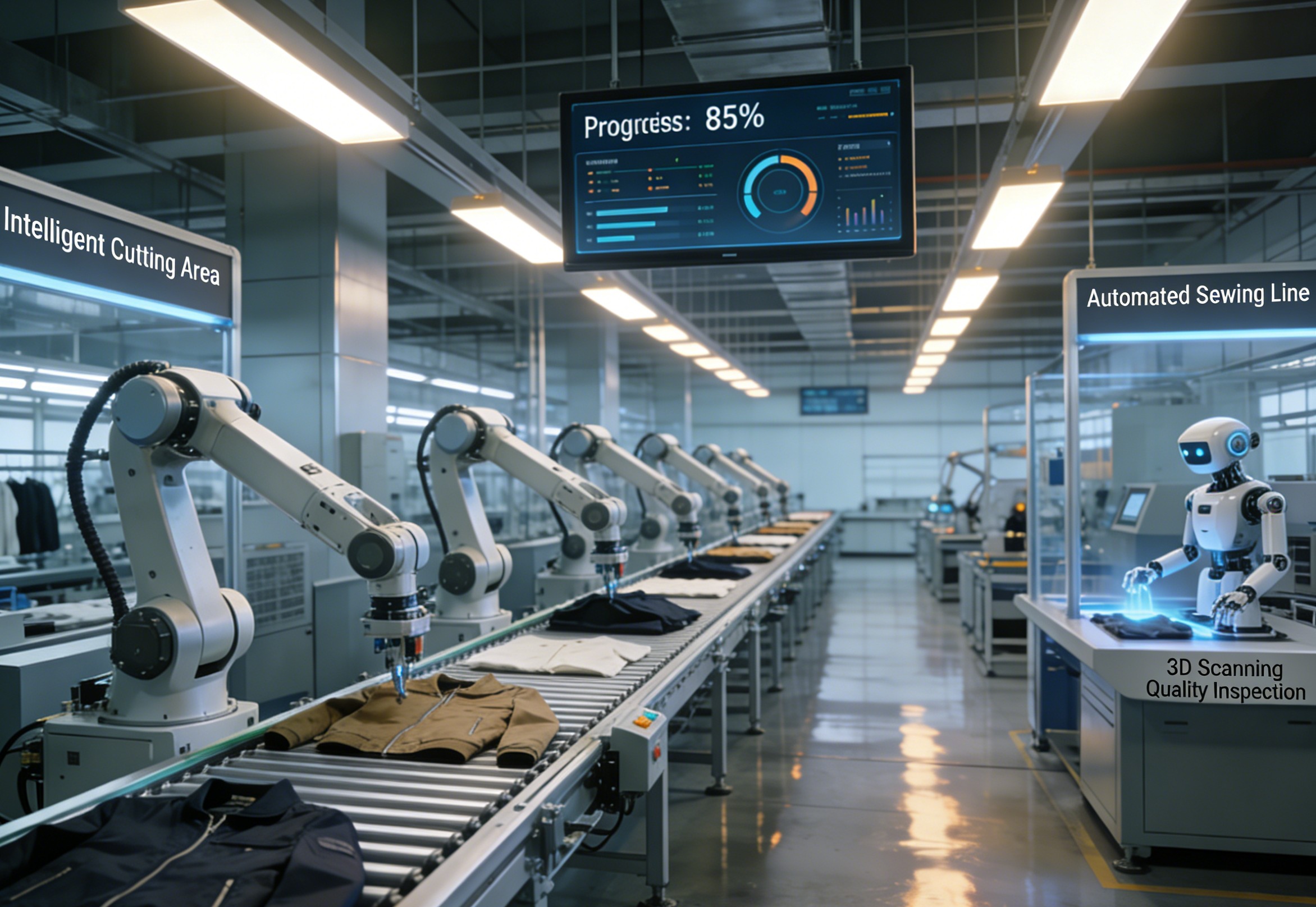
On the production side, smart manufacturing has become a core configuration for leading jacket factories, completely changing the traditional manual and semi-automated production modes. Automated production lines not only handle basic processes such as jacket sewing, fabric cutting, and finished product handling, but also, by being equipped with force feedback sensors, achieve adaptive adjustment of sewing force, effectively preventing damage to high-end fabrics during production and ensuring consistency in product patterns. At the same time, predictive maintenance systems monitor the operating status of production equipment in real time through big data, anticipating equipment failure risks in advance, reducing unplanned downtime by 90%, and extending equipment lifespan by 35%, greatly enhancing the stability and delivery efficiency of jacket production, helping enterprises respond quickly to market order demands.
The technological innovation in fabrics and processes has become the core support for jacket product upgrades. With the popularization of sustainable consumption concepts, eco-friendly materials have become the mainstream choice in jacket design. Among them, the market attention for jackets made of recycled leather and eco-friendly PU has soared by 68% year-on-year, gradually replacing traditional animal leather, combining fashion texture with green development needs. At the same time, the application of high-end functional fabrics has become more extensive. Advanced high-tech fabrics like GORE-TEX Pro ePE are widely used in outdoor hard-shell jackets. Taking Arc'teryx's 2026 new Beta SV jacket as an example, this fabric not only provides 100% waterproof and windproof performance but also offers super durability and breathability, perfectly suited for both professional outdoor adventures and urban commuting, becoming a benchmark product in the high-end jacket market. In addition, the promotion of new fabrics such as aerogel and high-elasticity abrasion-resistant materials allows jackets to maintain a structured fit while achieving a balance of lightness and functionality, further enhancing the consumer wearing experience.
What is even more noteworthy is that the application of blockchain technology in the jacket industry has thoroughly broken down the information barriers between the consumer and production ends, establishing a transparent trust system. Today, consumers only need to scan the unique QR code on the jacket tags to clearly view the full-chain product information, including the origin of the fabric and inspection reports, environmental standards of the dyeing process, live images of the production workshop, production hours, and the product's carbon footprint, achieving end-to-end traceability from 'factory to wardrobe.' According to the latest research by Boston Consulting, jackets with complete blockchain traceability capabilities see a 22% increase in brand premium and an 18% growth in consumer repurchase rates, especially favored by Gen Z consumers who value quality and environmental protection, becoming a key tool for brand differentiation in competition.
Currently, leading domestic jacket companies have taken the lead in technology-enabled transformation by introducing intelligent production equipment, deeply cooperating with fabric research institutions, and establishing blockchain traceability systems, gradually building core competitiveness. For example, Dragon Tooth, a domestic leader in tactical jackets, has introduced fully automated cutting and sewing production lines in its workshops, shortening the jacket production cycle by 40%, while also building a blockchain traceability platform so consumers can clearly understand the production details of each jacket. Bosideng has collaborated with fabric companies to develop new eco-friendly insulating fabrics and, combined with blockchain traceability technology, launched a high-end smart jacket series, further enhancing brand value.
Industry experts indicate that technology empowerment is not only an important means for the jacket industry to improve production efficiency and optimize product quality but also drives the industry from 'mass manufacturing' toward 'precision intelligent manufacturing + green intelligent manufacturing.' In the future, with the continuous iteration of technologies such as artificial intelligence, big data, and blockchain, the jacket industry chain will achieve deeper digital integration, fabric research will be more precise, the production process more efficient, and the consumer experience more transparent. Technological strength will become the core competitiveness for jacket brands in the market, promoting the entire industry toward higher quality and more sustainable development.
 Hot News
2026-03-06
2026-03-05
2026-03-03