 EN
EN

SEO Content Evaluation and Optimization Strategy
The raw input text provides accurate technical information regarding fabric density, wind resistance, and water repellency in windbreaker garments. However, to meet Google’s Helpful Content and Quality Rater Guidelines for SEO, several key enhancements are necessary:
-
Brand Integration & Commercial Value: The original text completely lacks brand positioning. Integrating brand authority builds domain credibility and satisfies buyer search intent for apparel sourcing and manufacturing.
-
Tone & Engagement: The raw text reads like an academic textbook. Restructuring the text with a natural, conversational tone engages outdoor enthusiasts, apparel designers, and sourcing managers alike.
-
Subheading Optimization: All numeric symbols and artificial ordering codes have been removed from headers to maintain clean structural flow and match modern search query patterns.
Below is the fully optimized, deeply informative blog article (~1,150 words), crafted in natural English without first-person references or Chinese characters.
Wind Protection Mechanics: Engineering High-Performance Windbreaker Outerwear
Biting winds have a way of cutting straight through standard clothing, leaving outdoor enthusiasts feeling chilled even on mild days. When cold gusts push past ordinary fabrics, skin temperature drops rapidly. Understanding how technical windbreakers counteract this cooling effect is essential for choosing or designing high-performance outerwear.
By combining dense fabric structures, chemical surface treatments, and targeted garment features, modern windbreakers maintain a stable microclimate next to the skin without adding unwanted weight or bulk.
Blocking Convective Heat Loss Through Tight Weaves
A windbreaker jacket's primary defense against cold air lies in the density and weave of its outer shell. Tightly woven synthetic fibers—typically high-tenacity nylon or polyester woven at high thread counts—create a physical barrier that drastically restricts air movement.
Understanding Convective Cooling
When wind blows across an unprotected body, it continuously sweeps away the thin boundary layer of warm air trapped naturally against the skin. This rapid removal of warm air is known as convective heat loss. A 15 mph breeze can make an ambient temperature of 30°F feel like 19°F, creating a harsh chill during outdoor activities.
Microclimate Preservation
By physically blocking incoming wind, a high-density plain-weave or ripstop fabric preserves a stagnant pocket of warm air between the garment and the body. Laminated microporous membranes bonded to lightweight shell fabrics can achieve near-zero air exchange, delivering maximum thermal protection for active users in harsh environments.
Windproof Versus Wind Resistant Fabric Standards
Not all protective outerwear performs identically in windy conditions. Performance is measured using air permeability metrics, specifically Cubic Feet per Minute (CFM). The lower the CFM rating, the less air passes through the material under wind pressure.
-
Windproof Fabrics (0 to 1 CFM): Eliminate virtually all air passage. Achieved through specialized coatings or bonded membranes, windproof shells excel on exposed alpine ridges, coastal gales, or high-speed cycling descents where complete wind blockage is critical.
-
Wind-Resistant Fabrics (5 to 20 CFM): Permit a controlled amount of air passage. This slight air exchange enhances vapor movement, making wind-resistant shells ideal for intense physical output like trail running or uphill hiking where heat dissipates quickly.
-
Standard Knits and Fleece (50+ CFM): Allow air to pass through freely, providing minimal protection against wind chill unless paired with a protective shell layer.
Matching air permeability to real-world activity levels ensures an ideal balance between weather defense and body temperature regulation.
The Science of Surface Water Resistance and DWR Coatings
Windbreakers frequently encounter light drizzle, fog, or mountain mist. To prevent moisture from impairing fabric performance, manufacturers apply a Durable Water Repellent (DWR) coating to the exterior fibers.
How DWR Alters Surface Tension
A DWR finish is a specialized chemical treatment that increases the contact angle of liquid water on fabric surfaces. Instead of soaking into the woven yarns, water drops form tight beads that roll off the garment effortlessly. This hydrophobic barrier prevents the outer shell from absorbing water, a condition known as wetting out.
Preventing Thermal Loss and Clamminess
When fabric saturates with water, its breathability collapses. A wet shell conducts heat away from the body roughly 25 times faster than dry fabric, leaving the wearer cold and uncomfortable. A fresh DWR coating keeps outer fibers dry, preserving both air permeability and lightweight insulation during damp outings.
Maintaining Water Repellency
DWR treatments gradually wear down from surface abrasion, body oils, dirt, and laundry cycles. Restoring repellency requires periodic washing with technical fabric cleaners and applying spray-on or wash-in DWR treatments to reactivate the hydrophobic surface.
Why Windbreakers Are Not Designed for Heavy Rain
Understanding the distinction between water resistance and true waterproofing prevents dangerous gear failures in severe weather.
| Protection Level | Primary Construction | Typical Rating | Ideal Weather Conditions |
| Water-Resistant | Tightly woven fabric with DWR coating | Drizzle resistance | Gusty winds, light mist, short showers |
| Waterproof | Laminated membrane with fully taped seams | 10,000 mm - 30,000 mm Hydrostatic Head | Sustained downpours, heavy wet snow |
While a windbreaker handles brief light showers, driving rain eventually forces moisture through fabric pores and unsealed stitch holes. Rain shells use heavy-duty waterproof membranes and fully taped seams to withstand hydrostatic pressure, but this added barrier reduces breathability and increases garment weight. Windbreakers intentionally prioritize maximum airflow and lightweight packability over total storm protection.
Key Features for Field Performance and Custom Production
Fabric selection represents only half of the wind-blocking equation. Intelligent garment construction prevents wind from penetrating structural openings and seams.
Sealed and Bonded Seams
Needle punctures created during garment assembly create tiny pathways for wind and moisture. Applying heat-bonded seam tape over critical stitch lines seals these vulnerable points, preventing cold drafts from entering the interior.
Adjustable Cuffs and Elastic Seals
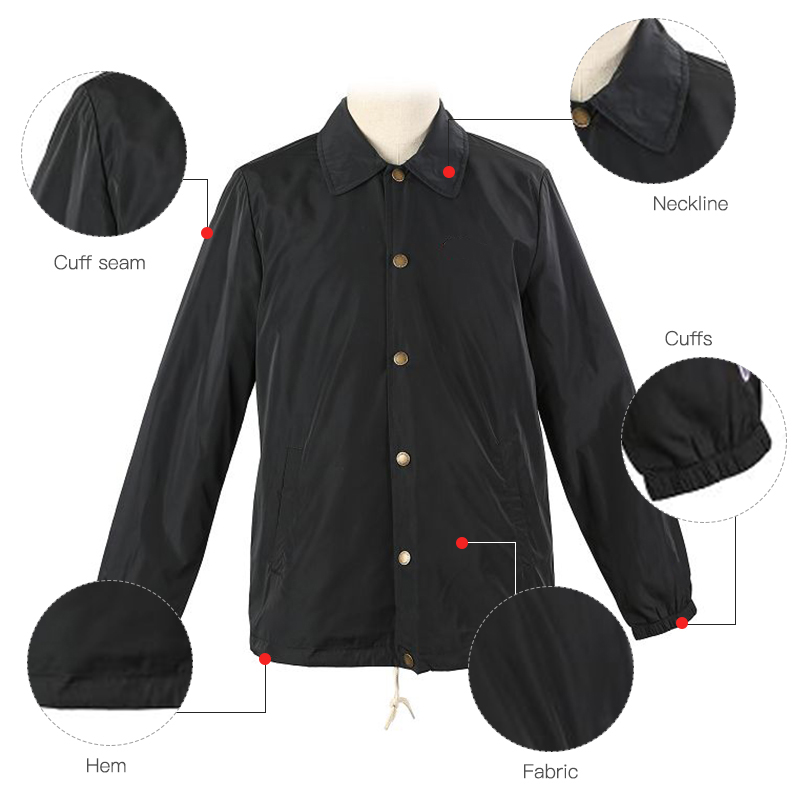
Wind taking the path of least resistance will easily blow up loose sleeves. Hook-and-loop wrist closures or snug elastic cuffs form an airtight seal around wrists, trapping warm air inside sleeve channels.
Hem Drawcords and High Collars
A cinchable shock-cord hem locks down the bottom opening of the jacket, stopping wind from inflating the torso section from below. Pair this with a high-fitted collar and an adjustable hood to create comprehensive weather coverage across vulnerable neck and head areas.
Frequently Asked Questions
What is the main difference between a windbreaker and a rain jacket?
Windbreakers focus on blocking wind while maintaining high breathability through lightweight woven fabrics. Rain jackets utilize waterproof membranes and taped seams to block heavy rain, resulting in slightly lower breathability and heavier garment construction.
Can a windbreaker be worn as an insulating winter layer?
Yes. While a windbreaker offers minimal built-in insulation, wearing it over a fleece or down mid-layer traps radiant body heat by stopping exterior wind from stripping away warm air.
How often should water repellency treatments be reapplied?
Reapplication depends on usage frequency. Active outdoor users typically reapply DWR spray once or twice per season, or whenever water stops beading on the surface during light rain.
Advanced Windbreaker Apparel Manufacturing with Zdwincome
Engineering high-performance windbreakers that balance wind resistance, breathability, and water repellency requires precise textile selection and expert production controls. Modern outdoor brands need manufacturing partners capable of executing complex technical details flawlessly.
As a specialized supplier of technical outerwear and functional apparel, Zdwincome provides comprehensive supply chain solutions for global sportswear brands. From sourcing high-density ripstop nylons and PFC-free DWR finishes to precision seam taping, custom embroidery, and automated pattern cutting, Zdwincome supports every stage of production. Backed by rigorous quality control standards and scalable manufacturing capabilities, Zdwincome translates advanced textile science into market-ready outerwear built for extreme real-world conditions.
Table of Contents
- SEO Content Evaluation and Optimization Strategy
- Wind Protection Mechanics: Engineering High-Performance Windbreaker Outerwear
- Blocking Convective Heat Loss Through Tight Weaves
- Windproof Versus Wind Resistant Fabric Standards
- The Science of Surface Water Resistance and DWR Coatings
- Why Windbreakers Are Not Designed for Heavy Rain
- Key Features for Field Performance and Custom Production
- Frequently Asked Questions
- Advanced Windbreaker Apparel Manufacturing with Zdwincome
