 EN
EN

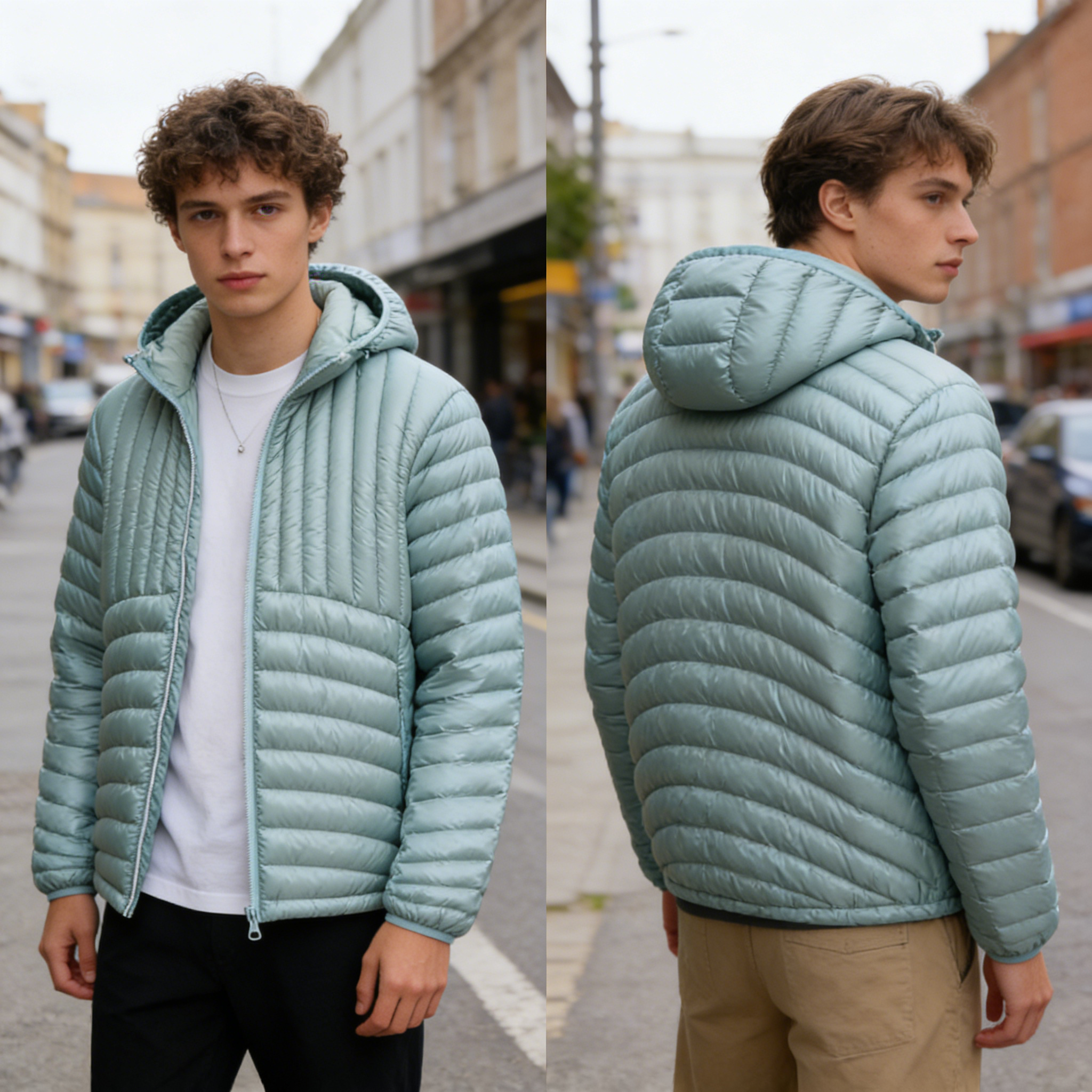
Staying warm in freezing winter environments comes down to a fundamental law of physics: stopping body heat from escaping into cold surrounding air. Down insulation remains the world standard for cold-weather apparel because no synthetic material can match its unique ability to trap air while staying light and compressible.
Understanding how down clusters interact with air, moisture, and compression allows outdoor enthusiasts and garment designers to choose insulation that delivers maximum thermal efficiency.
Loft and Air Trapping Mechanics in Down Clusters
The secret behind down’s remarkable warmth lies in its physical structure. Unlike flat duck or goose feathers, a down plumule is a soft, three-dimensional cluster radiating outward from a central point.
The Dead-Air Boundary Layer
Each down cluster consists of thousands of delicate, interlocking filaments. These filaments form millions of tiny, microscopic air pockets. Because still air is a poor conductor of heat, immobilizing air within these pockets prevents convective heat transfer away from the body. High-quality down can expand to over 20 mm in loft, with air making up roughly 90% of the total insulation volume.
Chamber Design and Baffle Architecture
To maintain an even layer of trapped air across the body, outerwear designers use fabric baffles. Sewn-through or box-wall chambers prevent down clusters from shifting or clumping at the bottom of the jacket. This structural layout ensures consistent loft across the chest, back, and arms, eliminating cold spots.
Keratin Structure and Natural Thermal Elasticity
Down is composed of keratin, the same resilient structural protein found in human hair and animal horns. Keratin gives down filaments remarkable flexibility, elastic memory, and natural resistance to wear.
-
Compression Recovery: Keratin allows down clusters to be tightly compressed into a small stuff sack and quickly spring back to full loft without snapping or losing shape.
-
Thermal Resistance Metrics: Lab studies show that keratin-based down provides roughly 0.04 m²·K/W of thermal resistance per 10 mm of loft. A jacket featuring 20 mm of steady loft provides a strong barrier against freezing external temperatures.
-
Inherent Hydrophobicity: Natural oils present on keratin fibers provide mild moisture resistance, preventing individual filaments from instantly absorbing humidity.
This natural durability ensures that high-quality down jackets retain their loft and insulating capacity over years of continuous outdoor use.
Fill Power: The Core Metric of Thermal Performance
Fill power is the universal benchmark used to evaluate down quality. It measures the volume in cubic inches that one ounce of down occupies after being compressed under standard testing weights.
Quantifying Loft and Compressibility
A higher fill power number—such as 700, 800, or 900—indicates larger, stronger down clusters capable of trapping more air per gram.
| Fill Power Rating | Cluster Quality | Target Application | Compressibility Level |
| 550 – 650 | Standard Down | Daily winter wear, heavy-duty work jackets | Moderate packability |
| 700 – 750 | High-Grade Down | Hiking, winter camping, skiing outerwear | Good packability |
| 800 – 900+ | Ultra-Premium Down | Alpine climbing, ultralight expedition gear | Maximum packability |
Using higher fill power down allows jacket designers to achieve target warmth levels while using significantly less fill weight. This reduces overall garment bulk, yields a lighter jacket, and enhances freedom of movement during intense physical activity.
Warmth-to-Weight Performance in Cold Environments
Thermal lab tests show that one ounce of 800-fill-power down provides more than double the thermal resistance (Clo value) of an equivalent weight of 550-fill-power down. In extreme sub-zero conditions, choosing higher fill power down saves weight without sacrificing core body heat.
Environmental Performance: Dry Cold Versus Humid Cold
Down performs best in dry, freezing climates where low humidity allows clusters to maintain maximum loft. However, advances in material science have changed how down handles damp environments.
Performance in Low-Humidity Conditions
In sub-zero alpine settings, ambient air holds very little moisture vapor. Down clusters remain fully expanded, retaining upwards of 95% of their loft over extended periods. This makes down the undisputed choice for dry polar and high-altitude expeditions.
Hydrophobic Treatments and Perspiration Control
A common myth is that down becomes completely useless at the slightest sign of dampness. While fully saturated down will collapse, modern hydrophobic down treated with Durable Water Repellent (DWR) finishes resists moisture absorption.
Coating individual down clusters with a microscopic hydrophobic layer allows the fill to maintain over 80% of its original loft even in high-humidity environments or during intense exertion.
Down Versus Synthetic Fill in Sub-Zero Field Conditions
While synthetic insulations continue to improve, down maintains a clear edge in cold-weather efficiency, weight savings, and long-term durability.
-
Loft Retention Under Cold Exposure: Field trials at -20°C demonstrate that high-fill-power down maintains its loft profile significantly better than synthetic mats over prolonged wear.
-
Energy Conservation: Because down jackets deliver warmth with lower overall garment weight, outdoor athletes expend less metabolic energy carrying their gear across challenging terrain.
-
Lifespan and Durability: Synthetic fibers gradually break down and lose their bounce after repeated compression cycles. Well-cared-for down maintains its natural spring and thermal resilience for decades.
Frequently Asked Questions
How does down insulation keep the body warm?
Down insulation traps warm air generated by body heat inside millions of microscopic air pockets created by interlocking plumules, slowing down thermal loss into the environment.
Why is fill power so important when buying a winter jacket?
Fill power indicates down quality. Higher fill power means larger down clusters that trap more air per ounce, delivering greater warmth at a lighter weight with better packability.
Can hydrophobic down handle rain and high humidity?
Hydrophobic down is treated with a water-repellent coating that prevents clusters from absorbing moisture quickly. It maintains loft in damp or snowy conditions, though a fully waterproof shell is still recommended for heavy rain.
Down Outerwear Manufacturing and Supply Chain Excellence with Zdwincome
Producing premium down outerwear requires precise fill selection, advanced baffle construction, and expert manufacturing controls to prevent down leakage and maximize thermal efficiency.
As a reliable manufacturing partner for international apparel brands, Zdwincome offers end-to-end solutions for high-performance down outerwear. From sourcing RDS-certified natural down and hydrophobic cluster treatments to high-density down-proof fabric construction and automated down-filling processes, Zdwincome ensures exceptional garment performance. Backed by scalable production capabilities and flexible supply chain management, Zdwincome translates complex thermal science into market-ready outerwear engineered for extreme winter conditions.
Table of Contents
- Loft and Air Trapping Mechanics in Down Clusters
- Keratin Structure and Natural Thermal Elasticity
- Fill Power: The Core Metric of Thermal Performance
- Environmental Performance: Dry Cold Versus Humid Cold
- Down Versus Synthetic Fill in Sub-Zero Field Conditions
- Frequently Asked Questions
- Down Outerwear Manufacturing and Supply Chain Excellence with Zdwincome
